English Parliament
The Man Who LaughsThe English Parliament stands at the center of the novel’s account of republican government and the Restoration that followed it. Its importance is both political and personal: the republican oath gives Linnæus, Lord Clancharlie, a stated reason for remaining in exile, while Parliament’s achievements and reversals become part of the narrator’s argument about power, loyalty, and the writing of national history.
Republican government and the Restoration
The novel presents 1660 as a decisive political turning point. After the republican government fell and the monarchy returned, Linnæus, Lord Clancharlie, could have resumed his place among the peers by returning to allegiance to Charles II. Instead, he remained faithful to the republic and voluntarily went into exile. His refusal makes the change of regime more than a transfer of power: it tests whether political conviction can survive the public celebration of a new order.
The narrator initially frames the Restoration in the language of national reconciliation. England is depicted as welcoming back its king, with the nation’s acclaim making dissent appear out of step with the general mood. From that perspective, Lord Clancharlie’s continued republican allegiance is treated by his contemporaries as stubbornness or folly. Yet the narrative also makes the cost of this consensus plain: while he could have been a peer, he chose the life of an exile rather than submit to the new political settlement.
The republic’s record and political memory
The novel’s account of the republic emphasizes the power it exercised under Oliver Cromwell. It describes English influence across Europe and at sea, the expansion of commerce and maritime authority, and a political order in which public speech and the press were comparatively free. These claims give the republic a forceful historical presence; it is not depicted merely as an interlude before the monarchy returned, but as a government that had altered England’s standing and challenged the established order of European rule.
That account is set against the Restoration narrative’s insistence that the nation had returned to proper order. The narrator presents the restored monarchy as a source of political and literary correction, even invoking the changed standing of Shakespeare and Dryden as part of the era’s supposed reordering of taste. This deliberate contrast exposes how historical judgment follows political victory: the same republican past can be remembered as achievement by one measure and as disorder by another. Lord Clancharlie’s fidelity to the defeated government becomes an individual refusal to accept the victorious account as the only possible one.
Oath, peerage, and institutional secrecy
A declaration drawn up by Parliament in 1650 required a promise of fidelity to the republic, without a king, sovereign, or lord. The narrator identifies this oath as the pretext under which Lord Clancharlie lived outside the kingdom. The oath thus links the institution directly to his personal history, while its language sets republican allegiance against the hereditary ranks to which he belonged.
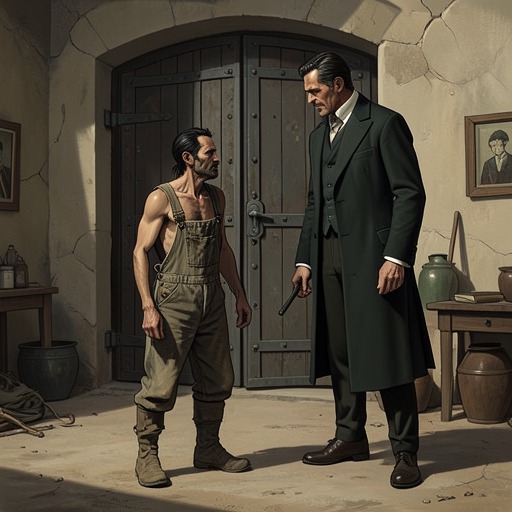
The surrounding political world remains sharply unequal. The novel describes a plebeian who strikes a lord as liable to lose his hand and treats the lord’s status as almost royal, with divine language extending the same hierarchy upward. These details do not establish Parliament as the source of each privilege; rather, they show the social order within which parliamentary and royal authority operate. Elsewhere, the account of state and parliamentary business stresses strict secrecy and the silence surrounding royal action. Together, oath and secrecy suggest that political institutions can both declare public obligations and conceal the exercise of power.
The House of Lords and the limits of a hearing
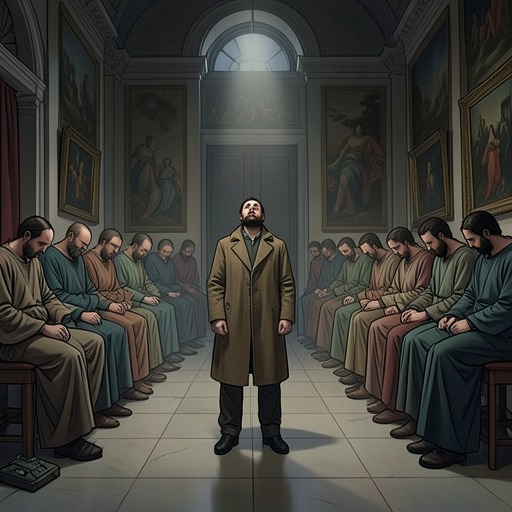
In the later parliamentary setting, the House of Lords gives the novel a stage on which inherited status determines who is heard and how. When Gwynplaine stands before the assembled peers, candlelight marks his face against the darkness of the chamber. By a brief effort of will, he suppresses his carved grin; the momentary change makes visible the struggle between his inner purpose and the appearance imposed on him.
Gwynplaine speaks from his experience of poverty and abandonment, attempting to address those who have lived above the pressure endured by the poor. His speech is cut across when emotion brings on his involuntary laughter. The peers respond with amusement and insult rather than continuing to listen. This episode concerns the House of Lords specifically, not every function of the English Parliament, but it gives the institution’s social hierarchy a present-tense dramatic form: entry into the chamber does not ensure that a speaker’s testimony will receive serious attention.
Across these episodes, the English Parliament belongs to a wider struggle over who may define political legitimacy and whose account of the nation will endure. Republican government, the oath of allegiance, royal restoration, and the later assembly of peers mark successive forms of authority. The contrast between Lord Clancharlie’s solitary fidelity and Gwynplaine’s mocked appeal shows how political memory and public hearing are shaped not only by institutions but also by the hierarchies those institutions preserve.